


The year was 2012, and I had just gotten the email that I’d been accepted into a study abroad program: six months in Sagunto, Spain, to learn Spanish. Six months to immerse myself in a new language, meet new people, and find my way through unfamiliar territory. At the time, it was also the furthest I had ever traveled, and I wanted to use the experience to disconnect from the noise waiting for me back home.
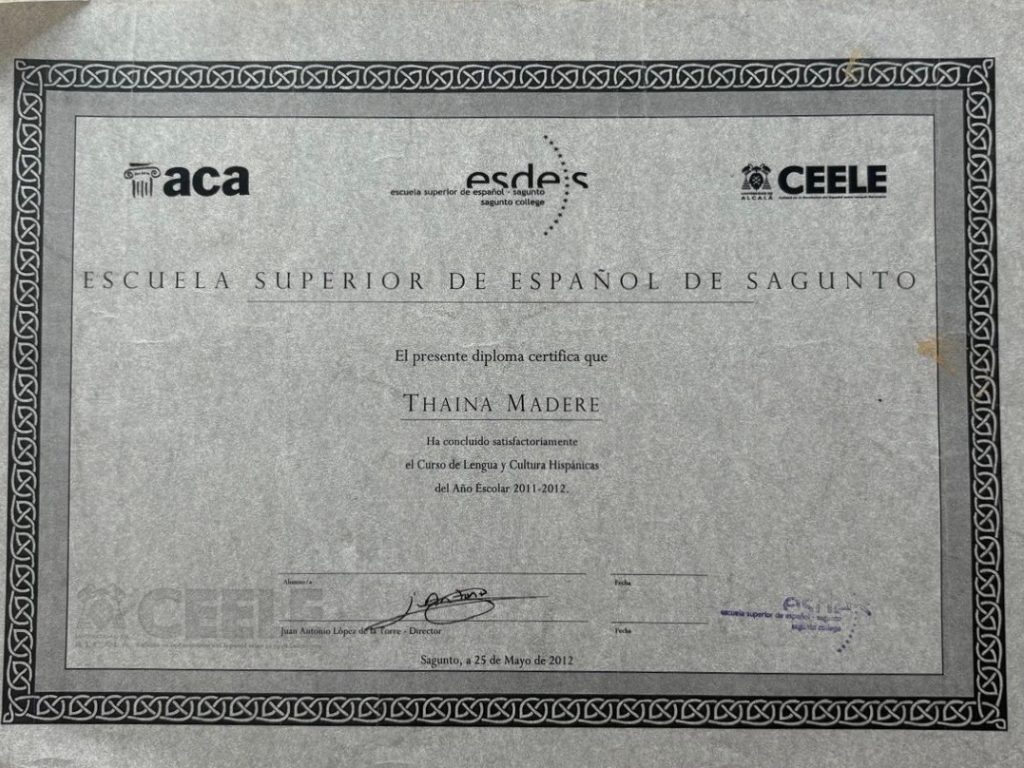
My certificate of completion from the Spanish immersion program
“I’m going to delete my Facebook,” I thought.
I was already planning to leave my cellphone behind because I didn’t have an international plan. Everywhere I went, I’d be with my classmates, teachers, and program leads, so I wouldn’t need it. I only took my laptop so I could keep up with loved ones through email and Skype.
It should’ve been simple: close the account and disappear for a while.
It wasn’t.
What followed was an unexpectedly arduous and confusing process that, even now, makes me wonder why something as simple as leaving a platform felt so difficult. Businesses naturally want to make the choices they want you to make easier and the choices they don’t want you to make harder (Harris, 2016).
And somehow, six months later, I felt compelled to download Facebook again, so I did.
Looking back, that experience feels like my first encounter with a social media design problem I didn’t yet have the language to describe: What happens when a platform is designed to make staying easier than leaving?
Back then, there was a hidden link.
In my account settings, I could easily find the option to deactivate my account. But when I wanted to actually delete it, the option seemed to disappear. I had to Google, “How to delete my Facebook account?” just to find the direct URL.
I remember hesitating before clicking it. Was this actually Facebook? Was I about to click some sketchy link and get my laptop hacked? I couldn’t understand why something as consequential as deleting my account wasn’t easy to find directly within the platform.
Eventually, I proceeded.
To request deletion, I had to go through a two-step verification process and fill out a CAPTCHA. You know, just in case I had somehow stumbled upon the secret passage to delete my own account by accident.
Then came the waiting period.
My deletion request would take two weeks to process. But there was a catch: if I, or apparently anyone else, logged into my account during that time, the request would be canceled.
Okayyyy, I thought.
I just have to avoid anything connected to Facebook for two weeks.
That admittedly wasn’t much back then. I didn’t have Instagram or TikTok or a dozen other accounts connected to my Facebook login. Still, the process had become surprisingly difficult for something I had already decided I wanted to do.
I don’t remember exactly what happened, but after a week and some change, I had to submit another deletion request.
Now I was looking at almost a month just trying to remove myself from Facebook.
Ugh.
There was a study done on the dark patterns of social media by the University of Chicago (Schaffner et al., 2022) in which I learned that Facebook increased the threshold to a 30-day wait period for deletion, making it even harder for a person wanting to go through the process.
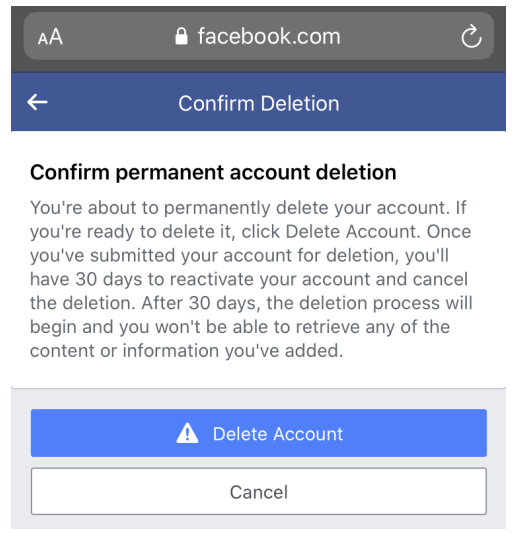
Image from Facebook on a mobile browser showing the ‘Delete After Closing’ account deletion option.
We know now that, in the internet world, “deleting” something doesn’t necessarily mean it disappears forever. But it sure was a lot of work for me just to create the illusion of a reset.
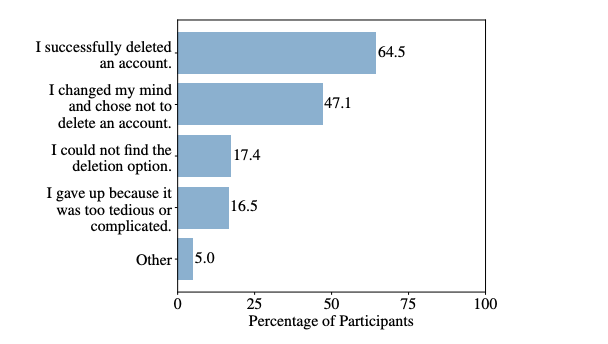
What happened when users tried to delete an account in the past? (Closed-ended responses) from the University of Chicago study on “Understanding Account Deletion and Relevant Dark Patterns on Social Media”
I didn’t have any other social media accounts back then, so eventually I went to Spain with my laptop and digital camera and lived my life for six months without social media.
I had wanted to disappear from Facebook for six months. Facebook made disappearing surprisingly difficult.
Here are some photos I took with my roommate in our dorm and down the street in Sagunto, Spain, that never made it to my Facebook page.






References
Harris, T. (2016, May 18). How technology is hijacking your mind—from a magician and Google design ethicist. Thrive Global. https://medium.com/thrive-global/how-technology-hijacks-peoples-minds-from-a-magician-and-google-s-design-ethicist-56d62ef5edf3
Schaffner, B., Lingareddy, N. A., & Chetty, M. (2022). Understanding account deletion and relevant dark patterns on social media. Proceedings of the ACM on Human-Computer Interaction, 6(CSCW2), 1–26. https://doi.org