

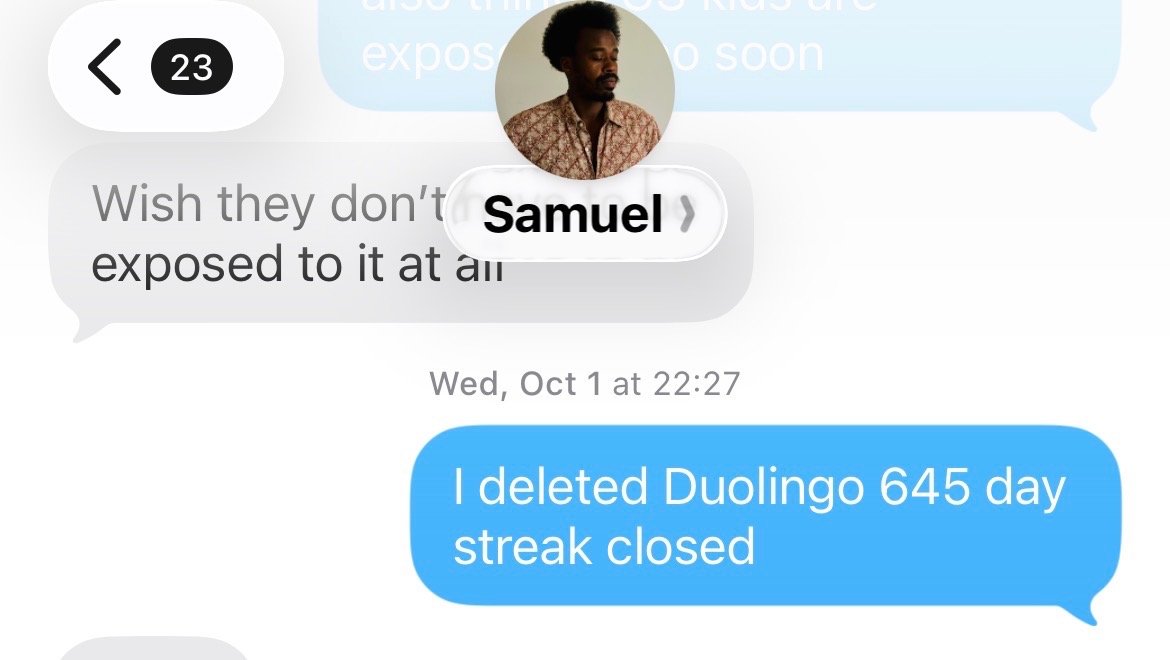
I started Duolingo because I wanted to become fluent at Spanish. Some odd days later, learning only became part of the reason I opened the app. I was also protecting something that became a part of my daily routine: my streak. On day 645 I finally asked myself the question: How did an app turn language learning into a behavior I felt compelled to repeat? I didn’t understand how to describe what needed investigation then, but now I can say the answer is behavioral economics.
Learning a language takes months or even years, which can feel more frustrating than motivating from day to day, so in order to keep a learner interested, they use streaks. The streak changes the focus from “Will this lesson help me to become fluent one day?” to “Am I willing to continue my streak today?
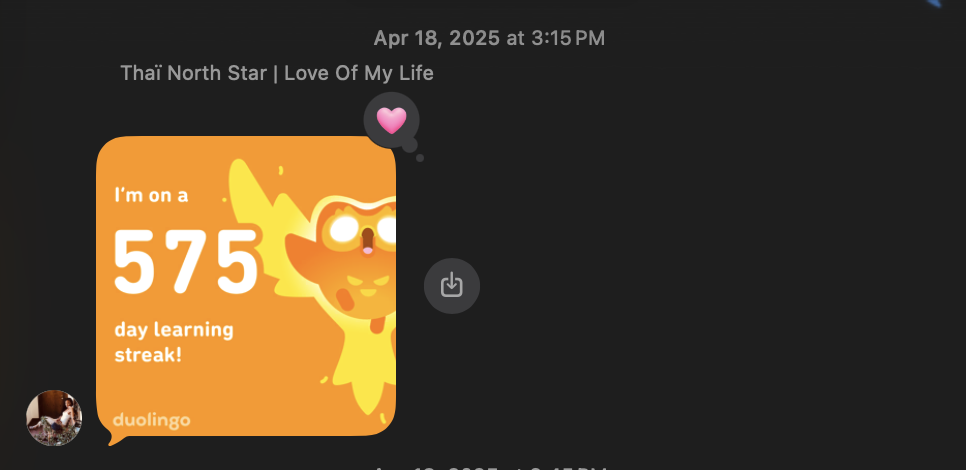
Sharing my streak progress in the family group chat
Duolingo’s in-app design includes a flame icon to encourage learners to keep going, and they reinforce engagement by sending personalized reminders via email about their streaks (Loh, 2017). On Duolingo’s blog they talk about how in order to make the streak even more motivating, they ran an A/B test. The learners who were offered to challenge themselves to a streak wager used the app more frequently, completed more lessons, and showed the greatest improvement as well as user retention.
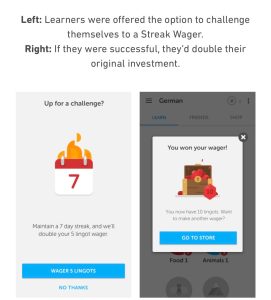
Duolingo’s A/B test from their blog. (Loh, 2017)
Our behavior is a series of choices, and the way a choice is presented largely determines what gets chosen. In hindsight, I can see multiple ways the app’s design influenced me to continue. One example is their reminder emails if I forgot to do a lesson that day. The emails would say something like, “Thaina, it’s almost midnight. You’ll lose your 47-day streak if you don’t come back today.” That email has a lot more influence than simply saying something like “keep your streak going” because presenting what I could potentially lose is a major motivator. This strategy is an example of using loss aversion to keep learners loyal to their commitments.

A celebratory screenshot to share after I completed a Duolingo challenge
It’s human nature to place more emphasis on immediate awards over long-term rewards, even if the payout for the latter is learning a new language. Duolingo designed their app in a way that addresses the conundrum of present bias (Sorkhou, 2026) by shifting the rewards to mini celebrations daily. We get XP points, gems, sound effects, games within the app, a rapport with their featured characters, and the opportunity to build a streak all as a way to influence our behavior and encourage us to continue the commitment to learning a new language.
The platform is so effective, with learners becoming streakers that they have hundreds and hundreds of users featured on DuoMe which is Duolingo’s unofficial streak hall of fame. The top streakers hold 4000+ days, which is close to the inception of the app. Behavioral economics presents the idea that people are susceptible to experiencing losses with more impact than equivalent gains. Duolingo’s streak gives learners something tangible to lose, and the longer the streak gets, the more psychologically significant it becomes.
In Kahneman’s (2011) book Thinking, Fast and Slow, he details how when something is easy to process, like recognizable fonts, simple language, and repeated actions (things you’ve seen before), people perceive it as more true and likable. He explains this concept, which is widely used in marketing and design as cognitive ease.
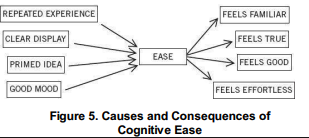
Figure 5 from Kahneman, D. (2011). Thinking, fast and slow
One example of how Duolingo uses this concept is with their characters. Duolingo has a list of animated characters, including Duo the owl, Lily, and Bea that have unique and playful personalities that bring the app to life (Duoplanet, 2022). Between and within the lessons, they’ll feature these personalities, which become an integral part of the user experience. I remember moments of relating to the characters and even giggling at some of the things they had to say. Intellectually I understood that these weren’t real people, but emotionally they created a community for learners like myself to immerse ourselves in.
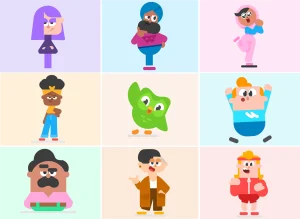
Duolingo characters from behance.net/gallery
What makes behavioral economics so interesting from a design perspective is that they’re not just making decisions about how something works and what it looks like but also shaping the choices a user encounters along the way. My experience is a case study for exactly that. Duolingo taught me some Spanish, but it also taught me a bit about design. Sometimes the most powerful feature isn’t the lesson itself but the reason the learner returns for the next one.
References
https://duome.eu
Kahneman, D. (2011). Page 61 of Thinking, fast and slow. Farrar, Straus and Giroux.
Loh, Kai.Herng (2017, May 10).How Streaks keep Duolingo learners committed to their language goals. Duolingo Blog https://blog.duolingo.com/how-streaks-keep-duolingo-learners-committed-to-their-language-goals/
Matt (2022, April 20) Duolingo Character Names: The Complete Guide on DuoPlanet. https://duoplanet.com/duolingo-character-names/
Sorkhou, M. (2026). Present bias: why we choose now over later. The Decision Lab. Retrieved September 20, 2026, https://thedecisionlab.com/biases/present-bias